![Dragon[flies]](https://blogger.googleusercontent.com/img/b/R29vZ2xl/AVvXsEg0rdzL89DxayHMMZPIHnxHCzrkUE4VK3tCQYW0K70dyNSj6HdJx4kLv_41Csqqjwd2-EoSONbs-deCGjZp0j8imW5eem6PA9s_0skoDWAbbIOgc-5yYdjvIFjZY4n6ayV-nf4ZC6ILlWX6/s1600-r/dragonredo.jpg)
1
I want to pick up those fragments
of final words
Sweep them away
as you swept me away
so they cannot pollute
all the words that
loved me.
2
With one match
I can set
your Valentine's Day gift on fire
Feel the warmth in my hands
And imagine
you're holding me
Watch the dancing flame
cast shadows
Kissing the walls
Hold onto this dream
as it falls
Showing posts with label feelings. Show all posts
Showing posts with label feelings. Show all posts
Friday, January 17, 2014

Reflecting
My dictionary sits on my chest
a choking brick
friction against my breasts
and still
in that weight
there are too few words,
Scrabble tiles spilled
beyond rearrangement,
with too few letters left
to spell out how I miss you.
Breaking up is the only part of a relationship where mutual consent seems no longer to hold a central place. Perhaps that is why, after so much honesty, caring, checking in and double-checking, the silence when this dissolves feels like such a betrayal even though she did nothing wrong. Sudden, and unilateral, and two weeks later I am left digging out the splinters left behind.
a choking brick
friction against my breasts
and still
in that weight
there are too few words,
Scrabble tiles spilled
beyond rearrangement,
with too few letters left
to spell out how I miss you.
Breaking up is the only part of a relationship where mutual consent seems no longer to hold a central place. Perhaps that is why, after so much honesty, caring, checking in and double-checking, the silence when this dissolves feels like such a betrayal even though she did nothing wrong. Sudden, and unilateral, and two weeks later I am left digging out the splinters left behind.
Sunday, October 13, 2013
Thoughts after camp
This was not how it was meant to be. In May, the mountain was a haven, and a place of understanding, more or less universally. This camp was largely that way, but for one fellow camper who shattered my sense of safety.
Everyone else said she is a good person who merely said inappropriate things and has a crass sense of humour. And yes, of course she is a good person. Good people, however, do fucked up things sometimes. When I saw her bothering another girl about her introversion, her facial expressions, her mannerisms...it looked more to me like bullying than horsing around. But it was the rape jokes that were hardest to hear. The threats were not genuine, but they were still disturbing. Oddly, the girl who was the target of those words insisted she was not upset; perhaps she was too drunk to recognize how bad those words sounded. Perhaps because we are women, it did not seem so serious. She saw herself as a bystander who should have intervened when the noise of their conversation kept me awake, and she apologized. But I saw myself as even more implicated, feeling too vulnerable to stand up and stop the hugely problematic things that were being said.
The others in the cabin were supportive, and fabulously so, totally there for me when I panicked and felt triggered. It was jarring to feel that triggered in what is otherwise a safe space, but I was relieved that most people there were focused on helping everyone feel as safe as possible in our cabin. I told a counsellor (for those unfamiliar with A-Camp - yes, we have counsellors, even though we are adults. And this is why we have counsellors. The staff are part of what makes this camp so safe, and so cohesive). She intervened, and the jokes stopped, but my sense of safety did not fully return. I cannot trust someone who says such things, even in jest, while intoxicated. I am saddened that none of us had the strength to discuss, in that moment, why this was problematic. I am worried that we see such "jokes" as commonplace, as innocent, rather than as a manifestation of rape culture. And it hurts to see this happen in a space that is otherwise so focused on safety, and that has otherwise been nothing but affirming to me as a survivor. The laughter and joy and pride and love at camp was there, but had to coexist with the vigilance, analysis, and fears that I had hoped to leave at home.
[I could easily write a gushing post about everything that was absolutely right about camp, and that I loved. I did overall have a wonderful time! But this here is my safe space to talk about things that aren't ok; people who know me in the real world have undoubtedly heard me pontificate about the good stuff almost endlessly, but I have not been as vocal about this part of the weekend]
Everyone else said she is a good person who merely said inappropriate things and has a crass sense of humour. And yes, of course she is a good person. Good people, however, do fucked up things sometimes. When I saw her bothering another girl about her introversion, her facial expressions, her mannerisms...it looked more to me like bullying than horsing around. But it was the rape jokes that were hardest to hear. The threats were not genuine, but they were still disturbing. Oddly, the girl who was the target of those words insisted she was not upset; perhaps she was too drunk to recognize how bad those words sounded. Perhaps because we are women, it did not seem so serious. She saw herself as a bystander who should have intervened when the noise of their conversation kept me awake, and she apologized. But I saw myself as even more implicated, feeling too vulnerable to stand up and stop the hugely problematic things that were being said.
The others in the cabin were supportive, and fabulously so, totally there for me when I panicked and felt triggered. It was jarring to feel that triggered in what is otherwise a safe space, but I was relieved that most people there were focused on helping everyone feel as safe as possible in our cabin. I told a counsellor (for those unfamiliar with A-Camp - yes, we have counsellors, even though we are adults. And this is why we have counsellors. The staff are part of what makes this camp so safe, and so cohesive). She intervened, and the jokes stopped, but my sense of safety did not fully return. I cannot trust someone who says such things, even in jest, while intoxicated. I am saddened that none of us had the strength to discuss, in that moment, why this was problematic. I am worried that we see such "jokes" as commonplace, as innocent, rather than as a manifestation of rape culture. And it hurts to see this happen in a space that is otherwise so focused on safety, and that has otherwise been nothing but affirming to me as a survivor. The laughter and joy and pride and love at camp was there, but had to coexist with the vigilance, analysis, and fears that I had hoped to leave at home.
[I could easily write a gushing post about everything that was absolutely right about camp, and that I loved. I did overall have a wonderful time! But this here is my safe space to talk about things that aren't ok; people who know me in the real world have undoubtedly heard me pontificate about the good stuff almost endlessly, but I have not been as vocal about this part of the weekend]
Sunday, September 29, 2013
Musings on the TRC
What does it mean to be a witness? To observe, and also have survived? The Truth and Reconciliation Commission BC National Event opened entire vats of worms in my mind. I volunteered at the events as a settler, born into colonial complicity with a VIP pass in my pale, freckled skin. And yet I felt echoes of my own survival that seeped through me all week, on the brink of triggering me. While not in my case coloured by colonialism, I know so well how it feels to lose parts of one's youth, innocence, and control, and to have school become a place of fear.
I was lucky. Privilege meant that home was a haven I could always return to. For residential school survivors, home was an elusive dream.
Two stories stood out this week, for me. A middle-aged white woman came to submit a report to the booth I was volunteering at while the staff member was on her lunch break. This woman sat down beside me to share that she had passed away at residential school as a child and was now reincarnated and on a spiritual quest to find her own grave. She had no identifying information to guide us, but an hour of intense emotions to share. I am skeptical of the spirituality of a white woman who uses such a space to air her fears. This space is not for her, not for me, but for the survivors, who experience ongoing pain from their lived experiences of this particular trauma. I listened, not wanting to dismiss a stranger in need, but it seems to me like an appropriation, taking me away from survivors looking to gain closure from the event.
Afterward, I shared my unease with a few friends, also history graduate students. Generally, they felt that the process was meant to heal all of us - colonizers and colonized. That her whiteness does not negate her need for support. But that's at odds with some of the Indigenous activists who attended the TRC, often expressing anger that settlers have been using this space to heal at a time when many Indigenous peoples are not yet ready. I would rather see people like myself being troubled at such an event, rather than healed. Yes, it is a space for mutual sharing, but it is unconscionable that a settler should have a voice here at the expense of a survivor. I fear that it is doubly violating for a bystander to claim a survivor's pain as her own.
When I listen to someone in need, I listen fully, multisensorily. For an hour or so, I did not look up as this woman shared her spiritual visions. I tried to respond with empathy rather than skepticism. And I cannot shake the blurred image of an elder, a survivor, unheard and standing behind or beside me, waiting for a turn to share or for some answers. I don't know if anyone was there waiting, or if her sharing took away someone's opportunity for closure. I'll never know. This troubles me.
I am finding some peace in the words of one friend, who remarked that this woman's very actions shows the potency of colonialism; whether spiritual or delusional, it is significant that this woman's thoughts congealed around the particular issue and trauma of residential schools. Appropriative or not, this is something that needed to be heard. But, perhaps not then, there, in that venue. I would take less issue if she published it on the internet, where there is almost infinite space for voices to echo, heard or silent. Or even in a letter, that the TRC could read on its own time. But not in an arena, full of survivors doing challenging healing work.
This need to be heard in an appropriate--not appropriative--space is one reason why I blog. We all need to be heard, perhaps especially about the things that polite society would see as too personal or shameful for the internet. Here, I am heard. But what do I do when the tables are turned, when it is my turn to hear? How does one bear witness, then process internally? I have learned to handle my own pain, gently, and knead it into something that I can cope with. The far larger suffering of others remains a challenge.
One man approached me at the TRC, just wanting to talk. Perhaps my volunteer t-shirt was an invitation, or that I was sitting alone at a picnic table on a lunch break. Perhaps he'd seen me earlier in the day at the booth I was volunteering at, talking to other survivors. This man was upset that he did not feel ready to make an official statement, yet still wanted--or needed--to share the horrors and shame he had lived through. So I listened, before directing him to more qualified emotional support. I will not write down nor verbally divulge what he told me; suffice to say that the abuses he faced are the stuff of nightmares. Even in the context of this event, what he shared was shocking.
This man's story was too big to grasp. The word "I" is powerful, too painful to situate in a sentence that recalls such cruelty. And perhaps that is why he spoke in the second person. You saw. You heard. You felt. You. Now I am holding the slivers from the shrapnel of his pain, distorted yet implanted inside me with his word "you." And though his experiences are not my own, the perpetual ghosts of hands on my body are something I, too, have felt. The pronouns he used pierced into me, and now I am cradling something that is, a week later, still undulating and unexplainable, a sort of tumour that has eclipsed my capacity for words. And yet, to excise this, to share it or bury it, would dishonour his courage in sharing. And yet, my own pain feels fraudulent, appropriative. I try to empathize with the pain of survivors by feeling in the dark for bridges between what we have survived, yet there is a depth that I simply cannot understand fully.
I know better than to dive into these depths, bring up algae-covered memories and scrape them raw in a search for my own understanding. I know better than to drain or dam a lake. Reconciliation seems daunting; it seems like a process for the settler, and not the survivor. What I am wondering now, I suppose, is whether non-Indigenous Canadians can ever be more than an invasive species in this land. Some may be zebra mussels, slicing feet and causing immobilizing pain. Others, perhaps, are bougainvillea; a parade of colourful umbrellas marching through the rain, cheerful hues and singing masking the potential for suffocation.
How do we navigate past this bottleneck, this paralyzed and paralyzing interstice of privilege and pain?
I was lucky. Privilege meant that home was a haven I could always return to. For residential school survivors, home was an elusive dream.
Two stories stood out this week, for me. A middle-aged white woman came to submit a report to the booth I was volunteering at while the staff member was on her lunch break. This woman sat down beside me to share that she had passed away at residential school as a child and was now reincarnated and on a spiritual quest to find her own grave. She had no identifying information to guide us, but an hour of intense emotions to share. I am skeptical of the spirituality of a white woman who uses such a space to air her fears. This space is not for her, not for me, but for the survivors, who experience ongoing pain from their lived experiences of this particular trauma. I listened, not wanting to dismiss a stranger in need, but it seems to me like an appropriation, taking me away from survivors looking to gain closure from the event.
Afterward, I shared my unease with a few friends, also history graduate students. Generally, they felt that the process was meant to heal all of us - colonizers and colonized. That her whiteness does not negate her need for support. But that's at odds with some of the Indigenous activists who attended the TRC, often expressing anger that settlers have been using this space to heal at a time when many Indigenous peoples are not yet ready. I would rather see people like myself being troubled at such an event, rather than healed. Yes, it is a space for mutual sharing, but it is unconscionable that a settler should have a voice here at the expense of a survivor. I fear that it is doubly violating for a bystander to claim a survivor's pain as her own.
When I listen to someone in need, I listen fully, multisensorily. For an hour or so, I did not look up as this woman shared her spiritual visions. I tried to respond with empathy rather than skepticism. And I cannot shake the blurred image of an elder, a survivor, unheard and standing behind or beside me, waiting for a turn to share or for some answers. I don't know if anyone was there waiting, or if her sharing took away someone's opportunity for closure. I'll never know. This troubles me.
I am finding some peace in the words of one friend, who remarked that this woman's very actions shows the potency of colonialism; whether spiritual or delusional, it is significant that this woman's thoughts congealed around the particular issue and trauma of residential schools. Appropriative or not, this is something that needed to be heard. But, perhaps not then, there, in that venue. I would take less issue if she published it on the internet, where there is almost infinite space for voices to echo, heard or silent. Or even in a letter, that the TRC could read on its own time. But not in an arena, full of survivors doing challenging healing work.
This need to be heard in an appropriate--not appropriative--space is one reason why I blog. We all need to be heard, perhaps especially about the things that polite society would see as too personal or shameful for the internet. Here, I am heard. But what do I do when the tables are turned, when it is my turn to hear? How does one bear witness, then process internally? I have learned to handle my own pain, gently, and knead it into something that I can cope with. The far larger suffering of others remains a challenge.
One man approached me at the TRC, just wanting to talk. Perhaps my volunteer t-shirt was an invitation, or that I was sitting alone at a picnic table on a lunch break. Perhaps he'd seen me earlier in the day at the booth I was volunteering at, talking to other survivors. This man was upset that he did not feel ready to make an official statement, yet still wanted--or needed--to share the horrors and shame he had lived through. So I listened, before directing him to more qualified emotional support. I will not write down nor verbally divulge what he told me; suffice to say that the abuses he faced are the stuff of nightmares. Even in the context of this event, what he shared was shocking.
This man's story was too big to grasp. The word "I" is powerful, too painful to situate in a sentence that recalls such cruelty. And perhaps that is why he spoke in the second person. You saw. You heard. You felt. You. Now I am holding the slivers from the shrapnel of his pain, distorted yet implanted inside me with his word "you." And though his experiences are not my own, the perpetual ghosts of hands on my body are something I, too, have felt. The pronouns he used pierced into me, and now I am cradling something that is, a week later, still undulating and unexplainable, a sort of tumour that has eclipsed my capacity for words. And yet, to excise this, to share it or bury it, would dishonour his courage in sharing. And yet, my own pain feels fraudulent, appropriative. I try to empathize with the pain of survivors by feeling in the dark for bridges between what we have survived, yet there is a depth that I simply cannot understand fully.
I know better than to dive into these depths, bring up algae-covered memories and scrape them raw in a search for my own understanding. I know better than to drain or dam a lake. Reconciliation seems daunting; it seems like a process for the settler, and not the survivor. What I am wondering now, I suppose, is whether non-Indigenous Canadians can ever be more than an invasive species in this land. Some may be zebra mussels, slicing feet and causing immobilizing pain. Others, perhaps, are bougainvillea; a parade of colourful umbrellas marching through the rain, cheerful hues and singing masking the potential for suffocation.
How do we navigate past this bottleneck, this paralyzed and paralyzing interstice of privilege and pain?
Monday, September 23, 2013
Monday, April 15, 2013
Meanings
I invest meaning in things that ought not be meaningful. Like in tomorrow. Abstract, socially constructed regimentation of the solar calendar. I am trying not to be scared, triggered. Trying to use my emotions as productive energy. I cannot be eaten by a date, an arbitrary thread, imaginary line linking the present to the past. I will not be smothered by an abstraction.
3652
That's how many days I've had this blog for (for the mathematically challenged, that's 10 years, less a day).
I'm doing a PhD in history. Studying change is something that I do. Studying stagnation, too. In 10 years I've seen change in the world, and I've seen it stagnate and go flat. Nothing changes, yet nothing stays the same. Same old story, what's the use of tears? What's the use of praying if there's nobody who hears? Turning, turning, turning turning turning through the years.
When I started this blog, it was all about me; my healing, my pain, my challenges. It was a private place; my mother knew where I kept my diary, but didn't know where to find me on the internet. Now, it's about bigger things, although the political is still very personal for me. Ten years ago, rape culture certainly existed, but wasn't labelled as such in popular discourse. The internet has given us a place for dialogue and social growth, but it is also a minefield, a sinkhole, a crevasse. Ten years ago, a teen was raped, but cell phones had no cameras, teens did not have Facebook, and text messaging was rare. Today, one click of a camera changes and ends lives. Perhaps it can bring justice, but not before bullying, stigma, and constant torment. The aftermath has changed immensely over the past ten years, and I cannot fathom how my horrors could have manifested themselves differently had they occurred in 2013, not 2003. Turning, turning, turning through the years; minutes into hours and the hours into years. Nothing changes, nothing ever can. Round and round the roundabout and back where you began.
Violence today has taken over the media; bombs went off in Boston at the finish line of the marathon, exploding bodies and changing and ending lives. Got me thinking about violence, and how we react to it as a society. Sudden violence brings sudden attention; everyone is asking whether the people they know in Boston are OK, clarifying the situation on the news. But not all violence is as explosive. People talk about rape how they talk about faraway violence in faraway wars - distant, abstract, a crime against bodies that are not our own. Civilian war casualties and rape survivors are unknown, anonymous, people who were in the wrong place at the wrong time; implicitly, people who did something wrong. Ten years ago, I hid my pain, my shame, my fear. I pushed it away from my mind for as long as I can. I talked about SARS, the illness that was terrifying Toronto, and not about the social ills that had hurt me. I talked about the war in Iraq, and not about the war and violence that is wrought daily on people closer to home. I had no words to talk about how I was hurting, and could only talk allegorically, abstractly.
Shootings, bombings, even natural disasters bring dialogue. It strikes at people that it could have been them, somebody they knew. And people talk about that. Rape is different. We hear about teens who have had their lives torn apart, but if people are thinking, "that could have been me," we don't say so. People talk about an abstract girl, usually one who did something wrong, a girl who should have, could have, done something differently. That girl is also me, could also be you. We are surrounded every day by people who have experienced horrible violence, and we are silent. Around the world, people die in wars with nary a mention in the media. But there is a war on our own soil, in every country in the world, and it's not the "war on terror." We are at war, in terror, changing our lives to avoid rape, averting our gaze while talking about rape in the assumption that it always happens to someone else, never to me, never to you. Invisible, silent, anonymous, insidious violence. It is probably eating somebody near you, consuming from within.
We see the blood, the physical manifestations of violence in Boston. But the explosions in the heart of a survivor, the daily amputations of parts of the soul - those are invisible. The marathon runners who witnessed and experienced trauma in Boston today will have a venue to talk about their fears, their pain. All violence is horrible, yet some violence is privileged in its social reception.
I do not mean here to silence the violence experienced by civilians targeted in war or terrorism, but there are parallels. We are abstract and silent on the massacres of people of colour in places far away. We are abstract and silent on the sexual violence faced primarily by women in places close to home. The emotional rawness that we see in discourses of non-sexual violence affecting people of privilege is absent when violence affects us at our most marginalized. Rape culture is silencing survivors, enabling and perpetuating violence. I have not lived in a war-torn nation. I fear that it may be appropriative to suggest that rape culture is a war, so this parallel is certainly problematic. Yet, with the barrage of abuses it entails, rape culture situates women's bodies, and other bodies that don't conform to hegemonic masculinity, in an abstract nation, far away. Like war, rape culture normalizes violence that happens in a far-away, abstract place. Like war, rape culture gives a louder voice to the perpetrators of violence than to its victims.
I've survived the past ten years. Personally, I've moved a long ways. I've won a battle. I am, and we are, still at war.
Must we always be at war?
Round and round and back where you began.
I'm doing a PhD in history. Studying change is something that I do. Studying stagnation, too. In 10 years I've seen change in the world, and I've seen it stagnate and go flat. Nothing changes, yet nothing stays the same. Same old story, what's the use of tears? What's the use of praying if there's nobody who hears? Turning, turning, turning turning turning through the years.
When I started this blog, it was all about me; my healing, my pain, my challenges. It was a private place; my mother knew where I kept my diary, but didn't know where to find me on the internet. Now, it's about bigger things, although the political is still very personal for me. Ten years ago, rape culture certainly existed, but wasn't labelled as such in popular discourse. The internet has given us a place for dialogue and social growth, but it is also a minefield, a sinkhole, a crevasse. Ten years ago, a teen was raped, but cell phones had no cameras, teens did not have Facebook, and text messaging was rare. Today, one click of a camera changes and ends lives. Perhaps it can bring justice, but not before bullying, stigma, and constant torment. The aftermath has changed immensely over the past ten years, and I cannot fathom how my horrors could have manifested themselves differently had they occurred in 2013, not 2003. Turning, turning, turning through the years; minutes into hours and the hours into years. Nothing changes, nothing ever can. Round and round the roundabout and back where you began.
Violence today has taken over the media; bombs went off in Boston at the finish line of the marathon, exploding bodies and changing and ending lives. Got me thinking about violence, and how we react to it as a society. Sudden violence brings sudden attention; everyone is asking whether the people they know in Boston are OK, clarifying the situation on the news. But not all violence is as explosive. People talk about rape how they talk about faraway violence in faraway wars - distant, abstract, a crime against bodies that are not our own. Civilian war casualties and rape survivors are unknown, anonymous, people who were in the wrong place at the wrong time; implicitly, people who did something wrong. Ten years ago, I hid my pain, my shame, my fear. I pushed it away from my mind for as long as I can. I talked about SARS, the illness that was terrifying Toronto, and not about the social ills that had hurt me. I talked about the war in Iraq, and not about the war and violence that is wrought daily on people closer to home. I had no words to talk about how I was hurting, and could only talk allegorically, abstractly.
Shootings, bombings, even natural disasters bring dialogue. It strikes at people that it could have been them, somebody they knew. And people talk about that. Rape is different. We hear about teens who have had their lives torn apart, but if people are thinking, "that could have been me," we don't say so. People talk about an abstract girl, usually one who did something wrong, a girl who should have, could have, done something differently. That girl is also me, could also be you. We are surrounded every day by people who have experienced horrible violence, and we are silent. Around the world, people die in wars with nary a mention in the media. But there is a war on our own soil, in every country in the world, and it's not the "war on terror." We are at war, in terror, changing our lives to avoid rape, averting our gaze while talking about rape in the assumption that it always happens to someone else, never to me, never to you. Invisible, silent, anonymous, insidious violence. It is probably eating somebody near you, consuming from within.
We see the blood, the physical manifestations of violence in Boston. But the explosions in the heart of a survivor, the daily amputations of parts of the soul - those are invisible. The marathon runners who witnessed and experienced trauma in Boston today will have a venue to talk about their fears, their pain. All violence is horrible, yet some violence is privileged in its social reception.
I do not mean here to silence the violence experienced by civilians targeted in war or terrorism, but there are parallels. We are abstract and silent on the massacres of people of colour in places far away. We are abstract and silent on the sexual violence faced primarily by women in places close to home. The emotional rawness that we see in discourses of non-sexual violence affecting people of privilege is absent when violence affects us at our most marginalized. Rape culture is silencing survivors, enabling and perpetuating violence. I have not lived in a war-torn nation. I fear that it may be appropriative to suggest that rape culture is a war, so this parallel is certainly problematic. Yet, with the barrage of abuses it entails, rape culture situates women's bodies, and other bodies that don't conform to hegemonic masculinity, in an abstract nation, far away. Like war, rape culture normalizes violence that happens in a far-away, abstract place. Like war, rape culture gives a louder voice to the perpetrators of violence than to its victims.
I've survived the past ten years. Personally, I've moved a long ways. I've won a battle. I am, and we are, still at war.
Must we always be at war?
Round and round and back where you began.
Wednesday, April 10, 2013
Adventures in mindfulness, part 4, or so.
The mindfulness group I've been attending all term ended tonight. I'll miss it. It was the hardest thing I've done in a long time, but really rewarding.
Dissociating has been my go-to coping strategy when things are really bad, for a good 10 years now. A few years ago, I learned to at least control it, and use it as an intentional coping strategy rather than a cop-out from my subconscious. I could get away from pain by taking a brief vacation from my mind and body, somehow. It's hard to explain if you've never dissociated. Five years ago, I managed to control flashbacks, so that I would dissociated into nothingness, rather than terror. This term, I've been working on being present, and riding with things that are painful. There were nights when that was crazily hard, but I got through.
This term has been a bit like trying to fix a hole in a knitting pattern. In order to go back, you have to rip some stitches, and that can be tricky, as there is a risk that everything might unravel. Even once you do succeed, sometimes there is still a kink in the thread where the problem was. It takes surrounding the messy part with clean parts to make the messy part blend in and not look so significant. I unravelled some of my emotions a bit this term, and have been re-knitting them. It still looks bumpy, but I'm hoping to have a well-formed sock in the end.
Dissociating has been my go-to coping strategy when things are really bad, for a good 10 years now. A few years ago, I learned to at least control it, and use it as an intentional coping strategy rather than a cop-out from my subconscious. I could get away from pain by taking a brief vacation from my mind and body, somehow. It's hard to explain if you've never dissociated. Five years ago, I managed to control flashbacks, so that I would dissociated into nothingness, rather than terror. This term, I've been working on being present, and riding with things that are painful. There were nights when that was crazily hard, but I got through.
This term has been a bit like trying to fix a hole in a knitting pattern. In order to go back, you have to rip some stitches, and that can be tricky, as there is a risk that everything might unravel. Even once you do succeed, sometimes there is still a kink in the thread where the problem was. It takes surrounding the messy part with clean parts to make the messy part blend in and not look so significant. I unravelled some of my emotions a bit this term, and have been re-knitting them. It still looks bumpy, but I'm hoping to have a well-formed sock in the end.
Sunday, March 17, 2013
I am so triggered tonight. I can feel everything happening to my body. I haven't felt that way in a long time.
I am a survivor and I have healed a good deal. But some nights are still hard, hard, hard.
It's been almost 10 years. One of my students is harassing me, following me, and it brings me back to 10 years ago, when things were starting to escalate...the media today, portraying Steubenville (more coherent post about that some other point!), saying all the horrible things I said to myself in the days, weeks, months, years I did not report or talk about it.
It gets easier but dammit, it just doesn't go away.
I am safe and taking care of myself, but feeling too many things to process them.
[Edited to add: it's morning now, and with the help of a few good friends and one squishy orange cat, I stayed grounded all night. It was surprising and scary for me to feel so bad, after so long - but I am OK and going to distract myself today with work, as a form of self care]
I am a survivor and I have healed a good deal. But some nights are still hard, hard, hard.
It's been almost 10 years. One of my students is harassing me, following me, and it brings me back to 10 years ago, when things were starting to escalate...the media today, portraying Steubenville (more coherent post about that some other point!), saying all the horrible things I said to myself in the days, weeks, months, years I did not report or talk about it.
It gets easier but dammit, it just doesn't go away.
I am safe and taking care of myself, but feeling too many things to process them.
[Edited to add: it's morning now, and with the help of a few good friends and one squishy orange cat, I stayed grounded all night. It was surprising and scary for me to feel so bad, after so long - but I am OK and going to distract myself today with work, as a form of self care]
Monday, February 18, 2013
Adventures in mindfulness, part...I forget
Oddest injury ever, and one that ought to only happen in movies:
I was doing a body scan (mindfulness exercise) yesterday morning, when my foster cat came to check out what I was up to. When he snuggled against my face, I sneezed, prompting him to swat at my nose. I am now sporting a cute little scratch on my schnoz.
There are certain things that it's hard to be mindful through, and that was one of them. I had to stop my practice for the morning and go and do first aid. Dang. Mindfulness and cats can only mix to a certain extent.
I was doing a body scan (mindfulness exercise) yesterday morning, when my foster cat came to check out what I was up to. When he snuggled against my face, I sneezed, prompting him to swat at my nose. I am now sporting a cute little scratch on my schnoz.
There are certain things that it's hard to be mindful through, and that was one of them. I had to stop my practice for the morning and go and do first aid. Dang. Mindfulness and cats can only mix to a certain extent.
 |
| Mellow Yellow: Adorable, but too inquisitive to be a good mindfulness buddy! |
Wednesday, February 13, 2013
Adventures in Mindfulness (part 3?)
Not much to reflect on today - I fell asleep!
My conclusion is that if my body wants to sleep, rather than be mindful, I shall let it. So I had two brief naps this evening, in lieu of body scanning. Oh well. I did also go for a lovely run.
My conclusion is that if my body wants to sleep, rather than be mindful, I shall let it. So I had two brief naps this evening, in lieu of body scanning. Oh well. I did also go for a lovely run.
Monday, February 11, 2013
Adventures in Mindfulness, Part 2
Just some short observations today. I've found that when trying to do things mindfully, rather than doing them mindfully, I find myself thinking quite intently about the need to do them mindfully. It's like there's a layer of wrapping around whatever activity I am doing, that I have not yet penetrated. This also means that even when I am not intending to do things mindfully, I find myself thinking that I should be.
Seeing as mindfulness is meant to be an intentional activity, does the very fact that it's intentional mean that we're thinking about it, and therefore, is that a problem? I've created a circle in my brain here.
Still the same deal with texture and food. I can eat, but not fully mindfully. It's weird now realizing that I've been neglecting a sensation for so much time.
Seeing as mindfulness is meant to be an intentional activity, does the very fact that it's intentional mean that we're thinking about it, and therefore, is that a problem? I've created a circle in my brain here.
Still the same deal with texture and food. I can eat, but not fully mindfully. It's weird now realizing that I've been neglecting a sensation for so much time.
Sunday, February 10, 2013
Adventures in Mindfulness (part 1?)
So, I'm doing a mindfulness program through the health and counselling services at my university. This is the second mindfulness-based therapeutic program I've tried out through the same service, and I'm feeling optimistic. The previous one was helpful, to an extent, but there were things that didn't sit right with me, that I won't get into here and now.
Back to mindfulness. I've tried meditating before, but it hasn't been good for me. Clearing my mind of everything has sent me into a dissociative spiral, and/or brought up things that are too scary for me to handle when I'm in the vulnerable space that meditation seems to put me into.
Mindfulness seems different, though. It's about being physically aware, from what I can gather - the opposite of dissociation. Knowing where my body is, how it feels, and how my feelings manifest themselves physically. This particular program asks for a lot of homework, meaning that aside from sleeping I'll be spending more time on mindfulness than on any other single non-academic activity in a given week.
It's very odd being aware of my body. I've spent years and years trying to shut it down, because of the memories attached to it, or because of physical pain of various sorts. It was actually surprising to find that engaging with my body was not a painful experience. I can feel things, physically, that are not pain, without having to do anything to feel other than think about feeling. As in, in the past I've only felt non-painful sensations in my body if I intentionally work to bring them on, such as through exercise. Perhaps this is something that most people take for granted; for me, it is not. This sort of connectedness has stayed with me for a few hours after I do mindfulness exercises, so that I have a non-painful engaged body for extended periods of time.
People who have read far back on this blog remember my rants about how academics detach bodies from people. I'm beginning to rethink that approach, seeing how detached I've always kept my body and my mind, and how marginalizing that is. I am not entirely sure what I am trying to say here, but I am trying to say something about reconceptualizing interactions between the body and the mind.
Mindful eating is another battle. It seems that I have for years shut down to some extent if I have anything in my mouth, to avoid triggering myself. One part of our homework this week is to eat one meal mindfully. I hadn't even realized how detached I was from touch-related sensations when I was eating, until on successive days I had to mindfully eat a raisin, then an M&M. I've always tasted what I eat, but somehow I think I haven't been feeling the texture of foods, or acknowledged that something is touching something in my mouth. I'm not sure how to explain it.
I haven't had PTSD triggers in quite some time, but eating mindfully means engaging with how things feel in my mouth, which is triggering. I became very triggered after eating an M&M in the Thursday group - the one that isn't working quite as well for me, for other reasons - then had to run to class. It wasn't a good way to work through the day, and I may leave the Thursday group, partly because of needing self-care time afterwards and not having a chance for that with my class schedule.
I suppose I've buried lots of memories in my mouth. I'm working very slowly on this. Very slowly. Today, I ate a corn chip mindfully, then had to stop. I'll work up to bigger things, I suppose. We'll see how it goes.
An odd thing came up in our group session on Wednesday. We did an exercise where we had to visualize a well, drop a (visualized) stone into it, and see what came up, in terms of our reasons for being in the program. I'm not sure if I'm explaining this particular exercise very well. At any rate, the purpose I assumed I came for - the stone I dropped in - was healing. I'm on a healing journey, right? That's why I signed up for mindfulness. Ultimately the word that came out of the well was, oddly, productivity. At first, I thought that was a sign from my subconscious, or something, that I was done healing, and now had to channel my healing energies into more productive things, and focus on my work. After trying some of the exercises at home, especially the mindful eating, I've realized that there must be some sort of blended purpose. Part of me is obviously aspiring for greater productivity - that's obvious. I am often stunted in my work because of my anxiety, and mindfulness will help me focus, academically. But the healing isn't over. I'm not sure whether healing ever will be over, whether it is finite. I am hoping this is the last painful bit I'll have to uncover, but I am not certain. There is a lot of uncertainty here.
At the very least, I am accompanied in my at-home mindfulness practice, for the next week or so, by Mellow Yellow, the Laziest Cat in the World, who flops down beside me and imitates my posture when I do body scans. It is comforting and brings a sense of camaraderie.
This has been a lot of navel-gazing, and I feel like writing a post to publicly muse as to why I feel a need to make all this healing public - I do know that I feel a need to, but haven't put it into words. That's for another night, I think.
Back to mindfulness. I've tried meditating before, but it hasn't been good for me. Clearing my mind of everything has sent me into a dissociative spiral, and/or brought up things that are too scary for me to handle when I'm in the vulnerable space that meditation seems to put me into.
Mindfulness seems different, though. It's about being physically aware, from what I can gather - the opposite of dissociation. Knowing where my body is, how it feels, and how my feelings manifest themselves physically. This particular program asks for a lot of homework, meaning that aside from sleeping I'll be spending more time on mindfulness than on any other single non-academic activity in a given week.
It's very odd being aware of my body. I've spent years and years trying to shut it down, because of the memories attached to it, or because of physical pain of various sorts. It was actually surprising to find that engaging with my body was not a painful experience. I can feel things, physically, that are not pain, without having to do anything to feel other than think about feeling. As in, in the past I've only felt non-painful sensations in my body if I intentionally work to bring them on, such as through exercise. Perhaps this is something that most people take for granted; for me, it is not. This sort of connectedness has stayed with me for a few hours after I do mindfulness exercises, so that I have a non-painful engaged body for extended periods of time.
People who have read far back on this blog remember my rants about how academics detach bodies from people. I'm beginning to rethink that approach, seeing how detached I've always kept my body and my mind, and how marginalizing that is. I am not entirely sure what I am trying to say here, but I am trying to say something about reconceptualizing interactions between the body and the mind.
Mindful eating is another battle. It seems that I have for years shut down to some extent if I have anything in my mouth, to avoid triggering myself. One part of our homework this week is to eat one meal mindfully. I hadn't even realized how detached I was from touch-related sensations when I was eating, until on successive days I had to mindfully eat a raisin, then an M&M. I've always tasted what I eat, but somehow I think I haven't been feeling the texture of foods, or acknowledged that something is touching something in my mouth. I'm not sure how to explain it.
I haven't had PTSD triggers in quite some time, but eating mindfully means engaging with how things feel in my mouth, which is triggering. I became very triggered after eating an M&M in the Thursday group - the one that isn't working quite as well for me, for other reasons - then had to run to class. It wasn't a good way to work through the day, and I may leave the Thursday group, partly because of needing self-care time afterwards and not having a chance for that with my class schedule.
I suppose I've buried lots of memories in my mouth. I'm working very slowly on this. Very slowly. Today, I ate a corn chip mindfully, then had to stop. I'll work up to bigger things, I suppose. We'll see how it goes.
An odd thing came up in our group session on Wednesday. We did an exercise where we had to visualize a well, drop a (visualized) stone into it, and see what came up, in terms of our reasons for being in the program. I'm not sure if I'm explaining this particular exercise very well. At any rate, the purpose I assumed I came for - the stone I dropped in - was healing. I'm on a healing journey, right? That's why I signed up for mindfulness. Ultimately the word that came out of the well was, oddly, productivity. At first, I thought that was a sign from my subconscious, or something, that I was done healing, and now had to channel my healing energies into more productive things, and focus on my work. After trying some of the exercises at home, especially the mindful eating, I've realized that there must be some sort of blended purpose. Part of me is obviously aspiring for greater productivity - that's obvious. I am often stunted in my work because of my anxiety, and mindfulness will help me focus, academically. But the healing isn't over. I'm not sure whether healing ever will be over, whether it is finite. I am hoping this is the last painful bit I'll have to uncover, but I am not certain. There is a lot of uncertainty here.
At the very least, I am accompanied in my at-home mindfulness practice, for the next week or so, by Mellow Yellow, the Laziest Cat in the World, who flops down beside me and imitates my posture when I do body scans. It is comforting and brings a sense of camaraderie.
This has been a lot of navel-gazing, and I feel like writing a post to publicly muse as to why I feel a need to make all this healing public - I do know that I feel a need to, but haven't put it into words. That's for another night, I think.
Saturday, December 22, 2012
A picture of a child
As always, this is a regular thought I grapple with - do I forgive the people who have hurt me tremendously, most particularly the young man at the root of much of my trauma? Ian Brown at the Globe and Mail today printed a lengthy piece on forgiveness. He muses that forgiveness is on some level essential to move forward, yet on another level nearly impossible without a range of conditions, generally involving an extent of reconciliation between the parties involved.
Brown's conclusions are ambiguous at best - not the holy grail in this lengthy internal journey. He does raise, however, a critical point near the end of his piece. Why is the onus on the victim (oh, I do hate that word), on the person wronged, to forgive? Should it not be on the perpetrator of violence, or broader wrongdoing, to seek forgiveness? Why must I forgive someone who might be in a position to commit the same violence to another person as he did to me, to hurt others once again? In my mental imagery, this "someone" is a monster who cannot be forgiven in a million years; a person of true evil, who has done unspeakable wrongs.
And so I went to my high school yearbooks, which I dug up the other day. A person who has done unspeakable wrongs? Well, that is unquestionable. I have never given details on this blog as to what happened, and have always been vague, not just because it hurts me to speak graphically and anatomically but also because it is too disturbing for most anyone who might read this. There was more wrong done on that day than there is room in my mind to process it. But a monster, a person of true evil? I found his picture in with the grade eleven students at my school, a few pages ahead of my grade nine photo. I never knew what he looked like, as I had very little vision when I met him, and not much more the day he raped me; I've closed my eyes each time since then that I've seen him, so I could not be triggered. The picture I found was of a child. In my flashbacks, his face has aged along with me, such that he became an adult. But in his picture, taken a few months before that day, he was a grinning boy, trying to grow a mustache, possibly, in a shapeless school uniform. A monster, and yet, a child. Evil, and yet, a child. Perhaps an adolescent would be a better description, but there is something distinctly boyish in his smile that I was never able to see. I have forgiven the children who bullied me years ago, because they were children. But I have always conceptualized him as an adult. Now, a child. Is a child able to commit rape on his own accord, as a budding sadist? Or is he a victim as I was, learning from media that taught him that violence would get him sexual gratification, and that placed this narrative in his hands? Is it his fault? Does he wonder about what he did, and how it hurt me? Does he care? Was it just a blip in his life, that he could forget as easily as what he learned in math class that day?
Is thinking about him and his feelings cannibalizing my own agency as a survivor, or fueling it? If he came to my door tomorrow to ask for forgiveness, as a man instead of a simultaneously terrifying yet somewhat impish boy, would I forgive him? Can I? If I forgive the child he was, must I then forgive the man he has become?
My mind is spinning tonight, and etched behind my eyes is a picture of two children...
Brown's conclusions are ambiguous at best - not the holy grail in this lengthy internal journey. He does raise, however, a critical point near the end of his piece. Why is the onus on the victim (oh, I do hate that word), on the person wronged, to forgive? Should it not be on the perpetrator of violence, or broader wrongdoing, to seek forgiveness? Why must I forgive someone who might be in a position to commit the same violence to another person as he did to me, to hurt others once again? In my mental imagery, this "someone" is a monster who cannot be forgiven in a million years; a person of true evil, who has done unspeakable wrongs.
And so I went to my high school yearbooks, which I dug up the other day. A person who has done unspeakable wrongs? Well, that is unquestionable. I have never given details on this blog as to what happened, and have always been vague, not just because it hurts me to speak graphically and anatomically but also because it is too disturbing for most anyone who might read this. There was more wrong done on that day than there is room in my mind to process it. But a monster, a person of true evil? I found his picture in with the grade eleven students at my school, a few pages ahead of my grade nine photo. I never knew what he looked like, as I had very little vision when I met him, and not much more the day he raped me; I've closed my eyes each time since then that I've seen him, so I could not be triggered. The picture I found was of a child. In my flashbacks, his face has aged along with me, such that he became an adult. But in his picture, taken a few months before that day, he was a grinning boy, trying to grow a mustache, possibly, in a shapeless school uniform. A monster, and yet, a child. Evil, and yet, a child. Perhaps an adolescent would be a better description, but there is something distinctly boyish in his smile that I was never able to see. I have forgiven the children who bullied me years ago, because they were children. But I have always conceptualized him as an adult. Now, a child. Is a child able to commit rape on his own accord, as a budding sadist? Or is he a victim as I was, learning from media that taught him that violence would get him sexual gratification, and that placed this narrative in his hands? Is it his fault? Does he wonder about what he did, and how it hurt me? Does he care? Was it just a blip in his life, that he could forget as easily as what he learned in math class that day?
Is thinking about him and his feelings cannibalizing my own agency as a survivor, or fueling it? If he came to my door tomorrow to ask for forgiveness, as a man instead of a simultaneously terrifying yet somewhat impish boy, would I forgive him? Can I? If I forgive the child he was, must I then forgive the man he has become?
My mind is spinning tonight, and etched behind my eyes is a picture of two children...
Friday, December 14, 2012
Little children
Same old story; what's the use of tears?
What's the use of praying when there's nobody who hears?
Turning, turning, turning turning turning through the years...
Watching the news this evening about the shootings in Connecticut and the stabbings in China, all I could do was think back to similar shootings and all the senseless rhyming in the recent history of school shootings and violence. I wrote a poem about this for Virginia Tech, years ago, and it sadly still rings true.
Sometimes the World Ends
Wednesday, November 28, 2012
My brain is trying to process...
A heavy blog night (don't worry, if you know me - I am actually totally ok, curled up with kittens and a lovely cup of tea, but writing about tough stuff)
A post on xojane, http://www.xojane.com/issues/rape-and-suicide (TRIGGER WARNING!!! talks about rape and suicide, PTSD, etc), got me thinking about that whole to-be-or-not-to-be thing. The blogger on xojane has survived several sexual assaults; for her, one more time would be the last straw. And this made me wonder - if it happened to me, again, what would I do? I want to think that it wouldn't happen, that lightning doesn't strike twice. Of course, life doesn't quite work that way; there is no life-long immunity to rape after it happens the first time. One of the commenters echoed what I think I feel about this as well - rather than it being the last straw, it would be another challenge to get through, but one that is perhaps easier than the first time, knowing that survival is possible even though it's hard as fuck.
So many folks in the comments (yes, I read the comments on everything...) say that they've always had suicide as a back-up plan. A friend of mine has often said the same thing for her life, and the possibility of having that last resort taken away from her was terrifying. I'm different (luckily, I guess) and I'm not sure what contributes to that. Not surviving has just never been an option that I'm willing to consider. It's letting him win.
Another thing I've been grappling with these past few weeks is the idea of forgiveness. It'll be 10 years this April, and I still cannot bring myself to look at his picture in my high-school yearbook for fear that I'll then know what he looks like (my eyesight was bad enough 10 years ago that I could not see him clearly enough to recognize him; in my mind, he doesn't have a face) and be able to know if I saw him on the street who he was - and I fear that then I'd kill him, or else explode with rage. So many people say to forgive, even though forgetting is impossible. I have trouble with that. I really do believe that some things cannot be forgiven.
Dying is letting him win; forgiving is letting him win; even as much as I'd like to push things aside, forgetting is letting him win. I can move past the flashbacks and surf on the waves of rage without being pulled under, but dammit if I'm going to venture inland.
[I still have never gotten a comment on this blog. If you read this, say hi?]
A post on xojane, http://www.xojane.com/issues/rape-and-suicide (TRIGGER WARNING!!! talks about rape and suicide, PTSD, etc), got me thinking about that whole to-be-or-not-to-be thing. The blogger on xojane has survived several sexual assaults; for her, one more time would be the last straw. And this made me wonder - if it happened to me, again, what would I do? I want to think that it wouldn't happen, that lightning doesn't strike twice. Of course, life doesn't quite work that way; there is no life-long immunity to rape after it happens the first time. One of the commenters echoed what I think I feel about this as well - rather than it being the last straw, it would be another challenge to get through, but one that is perhaps easier than the first time, knowing that survival is possible even though it's hard as fuck.
So many folks in the comments (yes, I read the comments on everything...) say that they've always had suicide as a back-up plan. A friend of mine has often said the same thing for her life, and the possibility of having that last resort taken away from her was terrifying. I'm different (luckily, I guess) and I'm not sure what contributes to that. Not surviving has just never been an option that I'm willing to consider. It's letting him win.
Another thing I've been grappling with these past few weeks is the idea of forgiveness. It'll be 10 years this April, and I still cannot bring myself to look at his picture in my high-school yearbook for fear that I'll then know what he looks like (my eyesight was bad enough 10 years ago that I could not see him clearly enough to recognize him; in my mind, he doesn't have a face) and be able to know if I saw him on the street who he was - and I fear that then I'd kill him, or else explode with rage. So many people say to forgive, even though forgetting is impossible. I have trouble with that. I really do believe that some things cannot be forgiven.
Dying is letting him win; forgiving is letting him win; even as much as I'd like to push things aside, forgetting is letting him win. I can move past the flashbacks and surf on the waves of rage without being pulled under, but dammit if I'm going to venture inland.
[I still have never gotten a comment on this blog. If you read this, say hi?]
Saturday, November 3, 2012
Wandering Mind
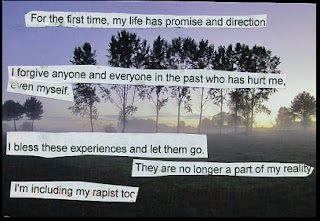
I'm technically working on a grant proposal tonight, but wandered over to PostSecret for a break.
This anonymous secret is a goal of mine, and something that has been suggested to me by many other people, including friends, my boxing coach, strangers on the internet. I am beginning to consider that they may be right; my anger is not productive.
Monday, June 25, 2012
"The R Word," Why now? and various other musings
First, another article I read and need to share. Warning that this is heavy - triggering, for some, and more graphic than most things I've ever posted. It's a discussion of the trivializing use of the word "rape," in this case specifically in video games: http://www.escapistmagazine.com/articles/view/features/9766-The-R-Word
I think I was especially struck by this article because it articulated so many of the arguments that I tried (and sometimes failed) to make in similar discussions, most notably one evening on Facebook last year when I argued about the term "Facebook rape" with some friends of friends who I didn't even know. That night hurt and sent me into a tailspin for a little while. The author of this article describes his own experiences in pretty stark detail, which is disconcerting but probably necessary to drive home his point, especially in the gaming world which is a harsh place where I don't hang out (not just because of things like this in gaming culture - also because I'm not great at video games!).
Some key quotations, for those not keen on clicking on the potentially triggering link:
"Despite all the articles, I have yet to see one that helps people understand, in detail, why this is such a personal topic for people who have had rape in their past. Perhaps it's our fault for not taking you there, for just assuming you'd care about something that for you is an abstract idea, but for us is a painful reality." Yes. So much. And it's so hard to hammer home that point to people...but that's exactly what this brave man did.
He voices the troubles faced by people with PTSD, rape survivors in particular, and this bit especially rings true: "My whole life I had felt worthless. I always tried harder than anyone because I was afraid of what authority figures, those who had power over me, would do if I failed. That's not uncommon for rape victims, it turns out. Trauma like that changes your brain chemistry, makes you feel helpless and inadequate even in situations you're perfectly capable of handling." My terror of authority is one of the few things that still really hinders me - at work, and in unexpected situations when I become afraid of people I merely perceive to be in positions of authority, such as more experienced drivers or better-dressed people on the street. I still cower in the face of criticism, and it wounds me in a way that is far from constructive. It is cliché to say that being a perfectionist is a weakness at work, but I do think in my case that it is. It means that when something goes wrong, and is noticed, that I dissolve entirely and have difficulty rebuilding, staying in a fearful mental space for far longer than is healthy or normal. Some of this may be due to being emotionally abused by a teacher in elementary school, compounded by years of bullying, but I do often think it was driven home by rape, which instilled in me an even deeper fear of how people in power truly could hurt me. Part of me, even years later, is still ensnared by that fear, which emerges whenever there is a situation that brings up even tangentially related emotions. It's not very productive!
Then the anonymous gamer makes a key point which I've never quite elucidated in my own arguments on this topic: the difference between hurt and offense. It seems obvious, but somehow is something I struggled to make clear to people when I objected to their words and became upset. In this case, again, his words are better than mine: "Often I won't say anything, even when I'm upset, because I don't want to be negative and ruin everyone's fun. Except "ruining fun" is exactly why I dislike it when people use that word. It ruins my fun. It sucks the fun out of a game like oxygen through a blown airlock. Being raped was the worst thing that ever happened to me, and I don't like to be reminded of it when I'm supposed to be enjoying myself. Imagine if someone captured your flag or dominated you in deathmatch, then rubbed in your face how your sister was killed by a drunk driver or your dad abandoned you when you were little. That's how close it cuts. People keep using the word "offended," in this discussion -- I'm not offended, I'm hurt. Hearing this word causes me emotional pain."
I'm hurt, not offended. This is what I wish I'd said, what I need to say, in so many similar situations. A little over a month ago, at a staff training retreat at work, several of us at lunch ended up talking about stalkers. I'm not sure how the topic came up - I certainly didn't introduce it. Someone in a more senior position to me mentioned how she'd been "stalked" by someone who gave her cookies and other baked goods, and how she'd not been fond of his behaviour but wanted to keep him around for the baking. She set up this supposed stalker with a friend of hers and they are close now.
I wanted to scream (but didn't; this is my boss we're talking about - and remember my issues with authority here! - it was also at work in a dining hall also crowded with staff whom I quasi-supervise). This isn't stalking we're talking about - this is an annoyance, petty behaviour. Stalking is a crime. Intimidation. Threats. Harassment. Not repeated purchase of cookies that stops when you ask nicely. I was stalked off and on for years by the man who raped me, and on a different occasion followed from my elementary school, threatened, and intimidated by a stranger as a child. Those are experiences I remember with terror - there is no humour in them and they are certainly not experiences I'd bring up as light lunchtime conversation with my colleagues. In my usual pattern, I retreated and proceeded to stew over it. I've been stewing since mid May, and it's now the end of June. It all brought me back to the inaccurate, trivializing, hurtful use of "rape" as a term to describe various virtual interactions that aren't very nice, but also aren't rape. Hurtful. I wasn't just offended by how this person, and other co-workers who mentioned having "stalkers" at various points, lightly told their stories as though talking about their first dates. I was profoundly hurt. She did not intend it, but something that terrified me for years became with this group of people a simple part of dating and courtship instead of the crime that it is. I felt jealous, confused, and angry - but most of all, hurt. And it's taken me a long time to put a finger on it, and to be able to explain to myself why I feel doubly wounded when somebody accuses me of simply being easily offended when I become upset about how people use these words.
I feel like I'm ranting at this point. I probably am. So I'll change gears. Another thing that's been on my mind these past few nights...why now? I've had enough of the "why me?" musings - they aren't productive and there is little I can do but accept that this happened to me. Happened. In the past. So why is it - "it" in this case being my past, issues of rape and bullying, trauma and the fear I always hid - hurting me more this spring than others?
This spring has been tumultuous for my family. My sister has been very ill, and our life has been turned upside-down. Things wrench inside of me because of the fear of losing her, almost every night. Simultaneously, a good friend is also struggling with mental illness that scares me - again, a feeling of loss with each night in the hospital, being overwhelmed and confused, terrified, and feeling helpless. All of this is a huge understatement. It will probably be a long time before I'll be able to really explain how this is all making me feel. One would think my mind would be wholly occupied with the daemons of its present, but instead in the long nights once I think things have subsided and I am finally about to sleep, the past awakens. I haven't had flashbacks again, thankfully, or hurt myself, but the anger and the fear from years ago has been flooding back. Why now? I've been puzzled by this. The best I can come up with is that there is some sort of a connection created by emotions in my brain.
I've been thinking about times and experiences as though they are islands, linked by bridges of emotion in my mind. Currently there is fear, anger, loss, hopelessness relating to my current situation and the fear of losing people whom I love. In the past, there was fear, anger, hopelessness, and so forth while being raped, and dealing with the aftermath of it, but those feelings were so intense I couldn't name them or recognize them at the time. The best I can surmise is that right now there is a bridge of sorts between those feelings, and that something inside of me is crossing over.
It's not fun. Hell no. But I am not as overpowered by my own feelings as I have been in the past. Somehow I know what they are now. Perhaps it's writing about them; perhaps it's time. In my Memories Series poem (which I posted last night while somewhat working through this post in my head), one line reads "Memories are fluid, and engulf me when it’s right \ To look at all the shattered glass that’s gathered in my knees. \ I pull out every shard of glass, and I keep up my fight: \ A fight that’s set on fire by my memories." Lately I've been wondering whether this is simply the time that my subconscious has chosen for pulling out at least some of the splinters that have been hurting me for years, which have become so engrained that I've become accustomed to them. Perhaps when I've been hurting so intensely because of other things in my life, I have the fuel to work through elements of my past that I usually keep buried so that I don't let those feelings free.
At work I jotted down today some things, just fragments, metaphorically linking this again to pulling out splinters: "healing is like pulling out deeply embedded splinters. Bleeding is inevitable even if the nerve endings have long since been severed. It's like unplugging something. It hurts unimaginably and acutely but is cleaner and less toxic than leaving a fragment to keep stabbing for eternity, fermenting, turning gangrenous inside of me."As a child I was always petrified of getting small slivers in my feet from running barefoot on the back deck, and I remember keenly the fear of my mother attempting to root out some stubborn splinters of wood, reluctantly and as gently as she could, with a sterilized needle. Now I know that slivers have to come out. Perhaps now is a time to release the splinters of wood, the slivers of the past, which have been catalyzed by my present fear. I can only hope that this won't be too dramatic or pull me down for too long.
I think I was especially struck by this article because it articulated so many of the arguments that I tried (and sometimes failed) to make in similar discussions, most notably one evening on Facebook last year when I argued about the term "Facebook rape" with some friends of friends who I didn't even know. That night hurt and sent me into a tailspin for a little while. The author of this article describes his own experiences in pretty stark detail, which is disconcerting but probably necessary to drive home his point, especially in the gaming world which is a harsh place where I don't hang out (not just because of things like this in gaming culture - also because I'm not great at video games!).
Some key quotations, for those not keen on clicking on the potentially triggering link:
"Despite all the articles, I have yet to see one that helps people understand, in detail, why this is such a personal topic for people who have had rape in their past. Perhaps it's our fault for not taking you there, for just assuming you'd care about something that for you is an abstract idea, but for us is a painful reality." Yes. So much. And it's so hard to hammer home that point to people...but that's exactly what this brave man did.
He voices the troubles faced by people with PTSD, rape survivors in particular, and this bit especially rings true: "My whole life I had felt worthless. I always tried harder than anyone because I was afraid of what authority figures, those who had power over me, would do if I failed. That's not uncommon for rape victims, it turns out. Trauma like that changes your brain chemistry, makes you feel helpless and inadequate even in situations you're perfectly capable of handling." My terror of authority is one of the few things that still really hinders me - at work, and in unexpected situations when I become afraid of people I merely perceive to be in positions of authority, such as more experienced drivers or better-dressed people on the street. I still cower in the face of criticism, and it wounds me in a way that is far from constructive. It is cliché to say that being a perfectionist is a weakness at work, but I do think in my case that it is. It means that when something goes wrong, and is noticed, that I dissolve entirely and have difficulty rebuilding, staying in a fearful mental space for far longer than is healthy or normal. Some of this may be due to being emotionally abused by a teacher in elementary school, compounded by years of bullying, but I do often think it was driven home by rape, which instilled in me an even deeper fear of how people in power truly could hurt me. Part of me, even years later, is still ensnared by that fear, which emerges whenever there is a situation that brings up even tangentially related emotions. It's not very productive!
Then the anonymous gamer makes a key point which I've never quite elucidated in my own arguments on this topic: the difference between hurt and offense. It seems obvious, but somehow is something I struggled to make clear to people when I objected to their words and became upset. In this case, again, his words are better than mine: "Often I won't say anything, even when I'm upset, because I don't want to be negative and ruin everyone's fun. Except "ruining fun" is exactly why I dislike it when people use that word. It ruins my fun. It sucks the fun out of a game like oxygen through a blown airlock. Being raped was the worst thing that ever happened to me, and I don't like to be reminded of it when I'm supposed to be enjoying myself. Imagine if someone captured your flag or dominated you in deathmatch, then rubbed in your face how your sister was killed by a drunk driver or your dad abandoned you when you were little. That's how close it cuts. People keep using the word "offended," in this discussion -- I'm not offended, I'm hurt. Hearing this word causes me emotional pain."
I'm hurt, not offended. This is what I wish I'd said, what I need to say, in so many similar situations. A little over a month ago, at a staff training retreat at work, several of us at lunch ended up talking about stalkers. I'm not sure how the topic came up - I certainly didn't introduce it. Someone in a more senior position to me mentioned how she'd been "stalked" by someone who gave her cookies and other baked goods, and how she'd not been fond of his behaviour but wanted to keep him around for the baking. She set up this supposed stalker with a friend of hers and they are close now.
I wanted to scream (but didn't; this is my boss we're talking about - and remember my issues with authority here! - it was also at work in a dining hall also crowded with staff whom I quasi-supervise). This isn't stalking we're talking about - this is an annoyance, petty behaviour. Stalking is a crime. Intimidation. Threats. Harassment. Not repeated purchase of cookies that stops when you ask nicely. I was stalked off and on for years by the man who raped me, and on a different occasion followed from my elementary school, threatened, and intimidated by a stranger as a child. Those are experiences I remember with terror - there is no humour in them and they are certainly not experiences I'd bring up as light lunchtime conversation with my colleagues. In my usual pattern, I retreated and proceeded to stew over it. I've been stewing since mid May, and it's now the end of June. It all brought me back to the inaccurate, trivializing, hurtful use of "rape" as a term to describe various virtual interactions that aren't very nice, but also aren't rape. Hurtful. I wasn't just offended by how this person, and other co-workers who mentioned having "stalkers" at various points, lightly told their stories as though talking about their first dates. I was profoundly hurt. She did not intend it, but something that terrified me for years became with this group of people a simple part of dating and courtship instead of the crime that it is. I felt jealous, confused, and angry - but most of all, hurt. And it's taken me a long time to put a finger on it, and to be able to explain to myself why I feel doubly wounded when somebody accuses me of simply being easily offended when I become upset about how people use these words.
I feel like I'm ranting at this point. I probably am. So I'll change gears. Another thing that's been on my mind these past few nights...why now? I've had enough of the "why me?" musings - they aren't productive and there is little I can do but accept that this happened to me. Happened. In the past. So why is it - "it" in this case being my past, issues of rape and bullying, trauma and the fear I always hid - hurting me more this spring than others?
This spring has been tumultuous for my family. My sister has been very ill, and our life has been turned upside-down. Things wrench inside of me because of the fear of losing her, almost every night. Simultaneously, a good friend is also struggling with mental illness that scares me - again, a feeling of loss with each night in the hospital, being overwhelmed and confused, terrified, and feeling helpless. All of this is a huge understatement. It will probably be a long time before I'll be able to really explain how this is all making me feel. One would think my mind would be wholly occupied with the daemons of its present, but instead in the long nights once I think things have subsided and I am finally about to sleep, the past awakens. I haven't had flashbacks again, thankfully, or hurt myself, but the anger and the fear from years ago has been flooding back. Why now? I've been puzzled by this. The best I can come up with is that there is some sort of a connection created by emotions in my brain.
I've been thinking about times and experiences as though they are islands, linked by bridges of emotion in my mind. Currently there is fear, anger, loss, hopelessness relating to my current situation and the fear of losing people whom I love. In the past, there was fear, anger, hopelessness, and so forth while being raped, and dealing with the aftermath of it, but those feelings were so intense I couldn't name them or recognize them at the time. The best I can surmise is that right now there is a bridge of sorts between those feelings, and that something inside of me is crossing over.
It's not fun. Hell no. But I am not as overpowered by my own feelings as I have been in the past. Somehow I know what they are now. Perhaps it's writing about them; perhaps it's time. In my Memories Series poem (which I posted last night while somewhat working through this post in my head), one line reads "Memories are fluid, and engulf me when it’s right \ To look at all the shattered glass that’s gathered in my knees. \ I pull out every shard of glass, and I keep up my fight: \ A fight that’s set on fire by my memories." Lately I've been wondering whether this is simply the time that my subconscious has chosen for pulling out at least some of the splinters that have been hurting me for years, which have become so engrained that I've become accustomed to them. Perhaps when I've been hurting so intensely because of other things in my life, I have the fuel to work through elements of my past that I usually keep buried so that I don't let those feelings free.
At work I jotted down today some things, just fragments, metaphorically linking this again to pulling out splinters: "healing is like pulling out deeply embedded splinters. Bleeding is inevitable even if the nerve endings have long since been severed. It's like unplugging something. It hurts unimaginably and acutely but is cleaner and less toxic than leaving a fragment to keep stabbing for eternity, fermenting, turning gangrenous inside of me."As a child I was always petrified of getting small slivers in my feet from running barefoot on the back deck, and I remember keenly the fear of my mother attempting to root out some stubborn splinters of wood, reluctantly and as gently as she could, with a sterilized needle. Now I know that slivers have to come out. Perhaps now is a time to release the splinters of wood, the slivers of the past, which have been catalyzed by my present fear. I can only hope that this won't be too dramatic or pull me down for too long.
Tuesday, May 1, 2012
What did homophobia have to do with being raped?
This is more pre-work to our TEACH storytelling workshop, which I wrote 5 days prior to the workshop itself. For the record, I still haven't managed to tell aloud any reworkings of my story for the group - more about that later.
Offside - this is my 50th public post!
Bear with me here - this is personal stuff, tough stuff. I don't usually think about connections between my own experiences or try to detangle things, so I would love comments/constructive criticism if anybody does read this.
TW for non-graphic discussion of rape
In my first year of high school, fitting in was paramount. Boys were a sudden new feature of my perplexing new social landscape. I knew that admitting that I was interested in them only as friends, and that I instead harboured a crush on the girl who sat next to me in science class, would be social suicide. It would mean a return to the bullying that had followed me from school to school for five years and which I hoped desperately to escape.
So when my sister told of a guy who she and a friend had a crush on, I thought it best to play along. I flirted back, awkwardly, and kept mum through fear when he first began to touch me in the halls. Saying no would, I thought, out me right away. And telling a teacher? After years of bullying from students and teachers alike, I was reluctant to trust them. Besides, he was acting the way I believed older high school boys were meant to behave. My response was to act like a typical teen girl; that is, to giggle and play along. I hoped that would let me maintain for my classmates the illusion of being straight. To me, it was a performance. For him, it was real. I didn't know how dangerous that could be.
The situation escalated. He pursued other girls as well, but they stood up for themselves. I was too scared to, and didn't fight him off when he casually but inappropriately touched me at my locker, my heart pounding and my insides shriveling up with shame. I'd sacrifice the private parts of my body to keep my real crushes private and protect my fledgling friendships. At the same time, I felt like a traitor to myself, and to my feminist values. I started to separate my body from my mind.
In early April of that year, I made plans to come out. A good friend was scheduled to visit from out of town over the Easter long weekend, and I planned to come out to her to test the waters. The idea was that if that went well, I'd tell my whole family at our upcoming Passover Seder. None of that ever happened.
The Wednesday before that weekend, the boy I'd feared and flirted with raped me after school.
My friend never visited that weekend; fears or a flu epidemic kept her home. I couldn't come out to her as practice. Besides, I felt guilty and tainted, fearing that I'd let this happen; that I was a phoney lesbian; that other women would shun me. I came to believe that, perhaps, I had deserved it.
After that, I couldn't tell my family. Besides, my mind was reeling and my body was so detached that I would touch my own hands numbly, doubting that they were mine. As the months passed, I began to wonder if I was even real. I hurt myself, to test if I existed and to see if I could feel more pain. Mostly I felt nothing but numbness. When I did feel anything, I felt grief for what I had lost: the sanctity of my body and the queer community which, by flirting with the boy who raped me, I thought I had betrayed.
On the second anniversary of the rape, I wrote a speech about feminism which a friend of mine read for my grade eleven English class. I told of how rape had reinforced my feminist views, and outed myself as a rape survivor. Yet I emphatically denied that I was a lesbian, telling my classmates that it was something I had thought about but that it didn't really describe me. I don't know what they made of that but it was, to an extent, true. At that point, I identified as asexual, thinking any hope I had of sexuality had been destroyed by rape, and denying the attractions that I felt towards women on the grounds that I didn't deserve those feelings. Now, I feel that asexuality wasn't the word or concept that I needed, but at the time it was a way for me to acknowledge for myself that I was certainly not straight. It also justified my own decision to trample my own same-sex attractions.
Overcome by pangs of jealousy when a friend came out as a lesbian, I called a queer youth helpline. They listened to me. They assured me that my past could not dictate my identity. The young woman at the end of the line never doubted me or denied my pain. She just said, "that's rough" and let me talk all I wanted. The guilt and uncertainty that had paralyzed me for two years began to melt away. I could almost feel my body thaw. It was not easy. Over the past few years I have felt and lived through the pain that I had denied by living separately from my own body. Dissociation, I have since learned, compounds physical pain and saves it for later, like a systemic burning regurgitation of an unwanted meal. That's not to say that I don't still sometimes dissociate - but it's a coping strategy I use when it's the safest thing to do at the time, rather than by default. I no longer hurt myself.
Days after calling the helpline, I came out to my immediate family, and in the weeks that followed, to some close friends. I was lucky to be surrounded by accepting and loving people. My fears of rejection and further abuse were unfounded. I only wish that I'd squarely faced homophobia and my fears of its potential impact before it blinded me to the positive forces that were with me, and within me, all along.
Offside - this is my 50th public post!
Bear with me here - this is personal stuff, tough stuff. I don't usually think about connections between my own experiences or try to detangle things, so I would love comments/constructive criticism if anybody does read this.
TW for non-graphic discussion of rape
What did homophobia have to do with being raped?
When it happened, I didn't see any connections. Just pain, shame, fear, and confusion. Now the links are more obvious. Homophobia was a catalyst, not a cause - in my case, rape was not a specifically homophobic crime - and it was one of the biggest hurdles that kept me silent.In my first year of high school, fitting in was paramount. Boys were a sudden new feature of my perplexing new social landscape. I knew that admitting that I was interested in them only as friends, and that I instead harboured a crush on the girl who sat next to me in science class, would be social suicide. It would mean a return to the bullying that had followed me from school to school for five years and which I hoped desperately to escape.
So when my sister told of a guy who she and a friend had a crush on, I thought it best to play along. I flirted back, awkwardly, and kept mum through fear when he first began to touch me in the halls. Saying no would, I thought, out me right away. And telling a teacher? After years of bullying from students and teachers alike, I was reluctant to trust them. Besides, he was acting the way I believed older high school boys were meant to behave. My response was to act like a typical teen girl; that is, to giggle and play along. I hoped that would let me maintain for my classmates the illusion of being straight. To me, it was a performance. For him, it was real. I didn't know how dangerous that could be.
The situation escalated. He pursued other girls as well, but they stood up for themselves. I was too scared to, and didn't fight him off when he casually but inappropriately touched me at my locker, my heart pounding and my insides shriveling up with shame. I'd sacrifice the private parts of my body to keep my real crushes private and protect my fledgling friendships. At the same time, I felt like a traitor to myself, and to my feminist values. I started to separate my body from my mind.
In early April of that year, I made plans to come out. A good friend was scheduled to visit from out of town over the Easter long weekend, and I planned to come out to her to test the waters. The idea was that if that went well, I'd tell my whole family at our upcoming Passover Seder. None of that ever happened.
The Wednesday before that weekend, the boy I'd feared and flirted with raped me after school.
My friend never visited that weekend; fears or a flu epidemic kept her home. I couldn't come out to her as practice. Besides, I felt guilty and tainted, fearing that I'd let this happen; that I was a phoney lesbian; that other women would shun me. I came to believe that, perhaps, I had deserved it.
After that, I couldn't tell my family. Besides, my mind was reeling and my body was so detached that I would touch my own hands numbly, doubting that they were mine. As the months passed, I began to wonder if I was even real. I hurt myself, to test if I existed and to see if I could feel more pain. Mostly I felt nothing but numbness. When I did feel anything, I felt grief for what I had lost: the sanctity of my body and the queer community which, by flirting with the boy who raped me, I thought I had betrayed.
On the second anniversary of the rape, I wrote a speech about feminism which a friend of mine read for my grade eleven English class. I told of how rape had reinforced my feminist views, and outed myself as a rape survivor. Yet I emphatically denied that I was a lesbian, telling my classmates that it was something I had thought about but that it didn't really describe me. I don't know what they made of that but it was, to an extent, true. At that point, I identified as asexual, thinking any hope I had of sexuality had been destroyed by rape, and denying the attractions that I felt towards women on the grounds that I didn't deserve those feelings. Now, I feel that asexuality wasn't the word or concept that I needed, but at the time it was a way for me to acknowledge for myself that I was certainly not straight. It also justified my own decision to trample my own same-sex attractions.
Overcome by pangs of jealousy when a friend came out as a lesbian, I called a queer youth helpline. They listened to me. They assured me that my past could not dictate my identity. The young woman at the end of the line never doubted me or denied my pain. She just said, "that's rough" and let me talk all I wanted. The guilt and uncertainty that had paralyzed me for two years began to melt away. I could almost feel my body thaw. It was not easy. Over the past few years I have felt and lived through the pain that I had denied by living separately from my own body. Dissociation, I have since learned, compounds physical pain and saves it for later, like a systemic burning regurgitation of an unwanted meal. That's not to say that I don't still sometimes dissociate - but it's a coping strategy I use when it's the safest thing to do at the time, rather than by default. I no longer hurt myself.
Days after calling the helpline, I came out to my immediate family, and in the weeks that followed, to some close friends. I was lucky to be surrounded by accepting and loving people. My fears of rejection and further abuse were unfounded. I only wish that I'd squarely faced homophobia and my fears of its potential impact before it blinded me to the positive forces that were with me, and within me, all along.
Thoughts before storytelling workshop
A few days ago we had a storytelling workshop at TEACH. Here's a piece I wrote a couple of weeks beforehand.
***
We have a storytelling workshop booked for later this month. I've been telling the same story, with just a handful of adjustments, for six years now. It's become engrained. I talk about positives: a loving family; finding community as a young adult; the freedom of finally finishing high school.
I hardly mention bullying, much less homophobic bullying. The kids excluded me, and I excluded myself, to varying degrees, for as long as I can remember. It's part of being an imaginative, intellectual kid. And the more excluded you are, the more awkward you become. And the circle continues.
I remember a kid calling my t-shirt "gay" when I was nine, at day camp. I told him that people could be gay, but shirts couldn't - was he stupid? - but that just made the other (bigger, cooler, sportier, more confident, prettier, smarter?) kids laugh. It hurt most when girls laughed at me, when I just wanted to impress them and join them.
So when the kids at my new school that fall called my outdated children's clothing "gay," I didn't speak up. I changed my clothes to something tighter and less childish, hated myself for giving in, and compromised that I'd wear only purple for the rest of the school year, just to keep some control.
The kids still teased me.
It was almost two years before someone next called me "gay." I was eleven years old, at camp - an all-girls overnight camp, this time - and one of my richer, prettier, more confident, and better-dressed cabin-mates called me a lesbian. I forget how it came up, other than that it was somehow part of the card game we were playing and "lesbian" basically was intended to be synonymous with "loser." I said that lesbians were cool and that I didn't want to play anymore. And that was it for any hope of friendship, or even peaceful cohabitation, with my cabin-mates. They didn't know what "lesbian" was other than an insult, when to me it was a word that I knew described some of my childhood role models. Unfortunately, I didn't know how to fight back.
That was really just the tip of the bullying iceberg...
***
We have a storytelling workshop booked for later this month. I've been telling the same story, with just a handful of adjustments, for six years now. It's become engrained. I talk about positives: a loving family; finding community as a young adult; the freedom of finally finishing high school.
I hardly mention bullying, much less homophobic bullying. The kids excluded me, and I excluded myself, to varying degrees, for as long as I can remember. It's part of being an imaginative, intellectual kid. And the more excluded you are, the more awkward you become. And the circle continues.
I remember a kid calling my t-shirt "gay" when I was nine, at day camp. I told him that people could be gay, but shirts couldn't - was he stupid? - but that just made the other (bigger, cooler, sportier, more confident, prettier, smarter?) kids laugh. It hurt most when girls laughed at me, when I just wanted to impress them and join them.
So when the kids at my new school that fall called my outdated children's clothing "gay," I didn't speak up. I changed my clothes to something tighter and less childish, hated myself for giving in, and compromised that I'd wear only purple for the rest of the school year, just to keep some control.
The kids still teased me.
It was almost two years before someone next called me "gay." I was eleven years old, at camp - an all-girls overnight camp, this time - and one of my richer, prettier, more confident, and better-dressed cabin-mates called me a lesbian. I forget how it came up, other than that it was somehow part of the card game we were playing and "lesbian" basically was intended to be synonymous with "loser." I said that lesbians were cool and that I didn't want to play anymore. And that was it for any hope of friendship, or even peaceful cohabitation, with my cabin-mates. They didn't know what "lesbian" was other than an insult, when to me it was a word that I knew described some of my childhood role models. Unfortunately, I didn't know how to fight back.
That was really just the tip of the bullying iceberg...
Subscribe to:
Posts (Atom)